Episode 6: Humans 2.0 and the Middle to Upper Palaeolithic Transition

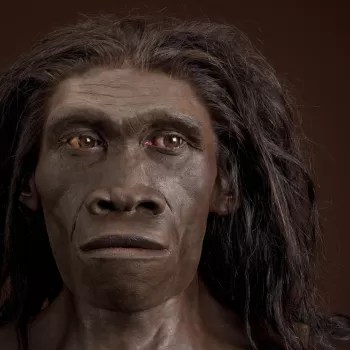
Over the last few weeks we have seen how humans and Neanderthals each lived in the Near East, how each was present in different areas, or in the same area at different times. This week humans move once again out of Africa and northwards across the Near East. Unlike in the Middle Palaeolithic, this time humans are here to stay and it will be the Neanderthals who eventually cease to be found in the Near East after about 40,000 years ago.

Examples of Middle (left)and Initial Upper (right) Palaeolithic chipped stone point types found in Initial Upper Palaeolithic layers at Levantine sites. Image adapted from Barzilai & Gubenko 2018.

The first indication that we have of the change into the Upper Palaeolithic comes from changes in the stone tools. As we know, the Middle Palaeolithic relied heavily on the use of the Levallois technique and the flakes or modified flake tools which were made using this method. Other types stone tools were around in the Middle Palaeolithic, but were found as more minor parts of the stone tools recovered from Middle Palaeolithic sites. One of these was blades, which are found in the Middle Palaeolithic but are only a small portion of the stone tools made.

Examples of some Upper Palaeolithic blades found at Initial Upper Palaeolithic sites. Image adapted from Barzilai & Gubenko 2018.

This changes in the Upper Palaeolithic, where the stone tool technology is dominated by blades and blade tools. However, in the early stages of the Upper Palaeolithic – the transition from the Middle to Upper Palaeolithic, sometimes called the earliest Upper Palaeolithic or the Initial Upper Palaeolithic, from about 49,000 to 40,000 years ago – we find Levallois flakes and other Mousterian tool types present as the minor component alongside this majority of blades. In other words, the Middle Palaeolithic distribution of stone tools has turned backwards, with the formerly minor part now being dominant, and also the reverse.

There are two ways of looking at the change from the Middle to the Upper Palaeolithic. One is the arrival of a new and unrelated way to doing things – making tools, hunting, gathering plants, etc. – from somewhere outside of either the Near East as a whole or outside of a particular region of the Near East. The other way of looking at this change is the local development of technology which sees major changes but ones which are evolving out of local traditions. Each of these has been argued to be the case in different areas of the Near East, with the introduction of an already-formed new tool technology in some parts of the Caucasus and the Zagros, and the development of new methods based on local traditions in the Levant and also in the Zagros.

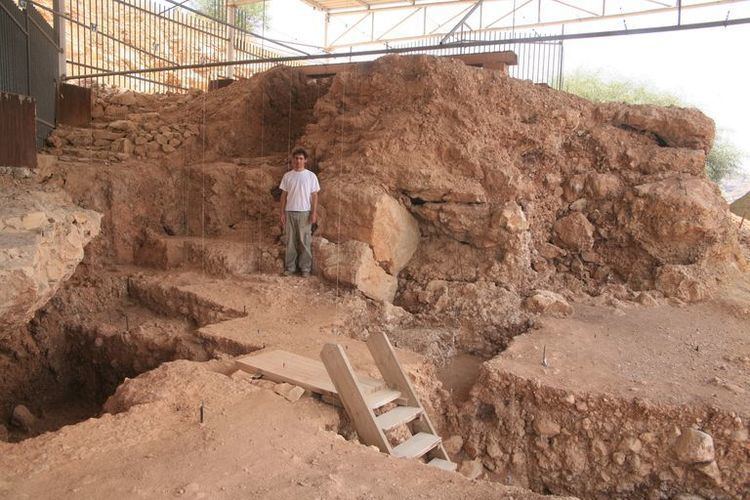
It is likely that both of these visions of the Middle to Upper Palaeolithic transition are correct, and that the change from one Palaeolithic to the other – and the change from Neanderthals to humans – may have been different depending on where in the Near East you were. In the Levant, new discoveries suggest that humans and Neanderthals lived in this same region (or at least in the southern parts) for several thousand years. Humans may even have arrived here a few thousand years before we see changes in the stone tools and other technology which we recognize as the beginnings of the Upper Palaeolithic.

Episode Bibliography:

Brzilai, O. and Gubenko, N. 2018. Rethinking Emireh Cave: the lithic technologyperspectives. Quaternary International 464: 92-105.

Becerra-Valdiva, L., Douka, K., Comeskey, D., Bazgir, B., Conard, N.J., Marean, C.W., Ollé, A., Otte, M., Tumung, L., Zeidi, M. and Higham, T.F.G. 2017. Chronometric investigations of the Middle to Upper Paleolithic transition in the Zagros Mountains using AMS radiocarbon dating and Bayesian age modelling. Journal of Human Evolution 109: 57-69.

Borgel, S., Latimer, B., McDermott, Y., Sarig, R., Pokhojaev, A., Abulafia, T., Goder-Goldberger, M., Barzilai, O. and May, H. 2019. Early Upper Paleolithic human foot bones from Manot Cave, Israel. Journal of Human Evolution doi.org/10.1016/j.jhevol.2019.102668

Friesem, D.E., Malinsky-Buller, A., Ekshtain, R., Gur-Arieh, S., Vaks, A., Mercier, N., Richard, M., Guérin, G., Vlladas, H., Auger, F. and Hovers, E. 2019. New data from Shovakh Cave and its implications for reconstructing Middle Palaeolithic settlement patterns in the Amud drainage, Israel. Journal of Paleolithic Archaeology 2: 298-337.

Gasparyan, B. and Arimura, M. 2014. Stone Age of Armenia: A Guide-Book to the Stone Age Archaeology in the Republic of Armenia. Kanazawa: Center for Cultural Resource Studies, Kanazawa University.

Ghasidian, E. 2013. The Early Upper Paleolithic Occupation at Ghār-e Boof Cave. A Reconstruction of the Cultural Tradition in the Southern Zagros Mountains of Iran. Tübingen: Kerns Verlag.

Ghasidian, E., Heydari-Guran, S. and Lahr, M.M. 2019. Upper Paleolithic cultural diversity in the Iranian Zagros mountains and the expansion of modern humans into Eurasia. Journal of Human Evolution 132: 101-118.

Goder-Goldberger, M., Crouvi, O., Caracuta, V., Horwitz, L.K., Neumann, F.H., Porat, N., Scot, L., Shavit, R., Jacoby-Glass, Y., Zilberman, T. and Boaretto, E. 2020. The Middle to Upper Paleolithic transition in the southern Levant: new insights from the late Middle Paleolithic site of Far’ah II, Israel. Quaternary Science Reviews 237: 106304.

Golovanova, L.V. and Doronichev, V.B. 2012. The Early Upper Paleolithic of the Caucasus in the west Eurasian context. In M. Otte, S. Shidrang and D. Flas (eds.), L’Aurignacian de la grotte Tafteh etson context (fouilles 2005-2008). Liège: ERAUL: 137-160.

Goring-Morris, N. and Belfer-Cohen, A. (editors). 2003. More than Meets the Eye: Studies on Upper Paleolithic Diversity in the Near East. Oxford: Oxbow Books.

Goring-Morris, N. and Belfer-Cohen, A. 2020. Noisy beginnings: the Initial Upper Paleolithic in Southwest Asia. Quaternary International 551: 40-46.

Greenbaum, G., Was inter-population connectivity of Neanderthals and modern humans the driver of the Upper Paleolithic transition rather than its product? Quaternary Science Reviews 217: 316-329.

Hershkovitz, I., Marder, O., Ayalon, A., Bar-Matthews, M., Yasur, G., Boaretto, E., Caracuta, V., Alex, B., Frumkin, A., Goder-Goldberger, M., Gunz, P., Holloway, R.L., Latimer, B., Lavi, R., Matthews, A., Slon, V., Bar-Yosef Mayer, D., Berna, D., Bar-Oz, G., Yeshurun, R., May, H., Hans, M.G., Weber, G.W. and Barzilai, O. 2015. Levantine cranium from Manot Cave (Israel) foreshadows the first European modern humans. Nature 520: 216-219.

Kadowaki, S., Tamura, T., Sano, K., Kurozumi, T., Maher, L.A., Wakano, J.Y., Omori, T., Kida, R., Hirose, M., Massadeh, S. and Henry, D.O. 2019. Lithic technology, chronology, and marine shells from Wadi Aghar, southern Jordan, and Initial Upper Paleolithic behaviours in the southern inland Levant. Journal of Human Evolution 135: 102-646.

Kuhn, S.L. 2004. From Initial Upper Paleolithicto Ahmarian at Üçağizli Cave, Turkey. Anthropologie 42(3): 249-262.

Nasab, H.V., Berillon, G., Jamet, G., Hashemi, M., Jayez, M., Khaksat, S., Anvari, Z., Guérin, G., Heydari, M., Kharazian, M.A., Puaud, S., Bonilauri, S., Zeitout, V., Sévêque, N., Khatooni, J.D. and Khaneghah, A.A. 2019. The open-air Paleolithic site of Mirak, northern edge of the Iranian Central Desert (Semnan, Iran): evidence of repeated human occupations during the Late Pleistocene. Comptes Rendus Palevol 18: 465-478.

Nishiaki, Y. and Akazawa, T. (editors). 2018. The Middle and Upper Paleolithic Archaeology of the Levant and Beyond. London: Springer.

Pearson, O.M., Pablos, A., Rak, Y. and Hovers, E. 2020. A partial Neandertal foot from the Late Middle Paleolithic of Amud Cave, Israel. PaleoAnthropology 144: 98-125.

Pinhasi, R. Gasparian, B., Wilkinson, K., Bailey, R., Bar-Oz, G., Bruch, A., Cataigner, C., Hoffman, D., Hovsepyan, R., Nahapetyan, S., Pike, A.W.G., Schreve, D. and Stephens, M. 2008. Hovk 1and the Middle and Upper Paleolithic of Armenia: a preliminary framework. Journal of Human Evolution55: 803-816.

Sarig, R., Fornai, C., Pokhojaev, A., May, H, Hans, M., Latimer, B., Barzilai, O., Quam, R. and Weber, G.W. 2019. The dental remains from the Early Upper Paleolithic of Manot Cave, Israel. Journal of Human Evolution doi.org/10.1016/j.jhevol.2019.102648

Stiner, M.C., Munro, N.D. and Surovell, T.A. 2000. The tortoise and the hare: small-game use, the broad-spectrum revolution and Paleolithic demography. Current Anthroplogy 41(1): 39-73.

Tsanova, T. 2013. The beginning of the Upper Paleolithic in the Iranian Zagros. A taphonomic approach and techno-economic comparison of Early Bardostian assemblages from Warwasi and Yafteh (Iran). Journal of Human Evolution 65: 39-64.

Episode 5: Middle Palaeolithic Humans in Arabia

After taking a look at Neanderthals last week, this week we take a look at how what we know about the lifestyles and habits of Middle Palaeolithic humans compares with what we know about Neanderthals. In comparison with Neanderthals, the evidence that humans buried their dead, that they may even have included grave goods in a couple of cases, and that Anatomically Modern Humans may also have decorated themselves with ochre and jewelry is still argued about in archaeology – but is far less hotly argued that the evidence for these self-aware activities when we are looking at Neanderthals.

Burial 11 from Qafzeh cave, Israel. On the left is a photo taken part-way though excavating the grave, showing the upper portion of the skeleton and the deer antlers clasped in the hand. On the right is a drawing of the burial showing the same. Image from Vandermeersch & Bar-Yosef 2019. The complete article can be found for free here.

We can generally think of Anatomically Modern Humans in pretty much the same way that we think of ourselves, just with all of our technology stripped off. In other words, we can think of them in a lot of the same ways that we can think of Neanderthals. They may have used their landscape a bit differently and moved around more, but they were probably just as intelligent and introspective as we humans are today.

Some of the Middle Palaeolithic shell pendants worn by humans living at Qafzeh cave. Image taken from Bar-Yosef Mayer et al 2009.

Anatomically Modern Humans are best known from moving out of Africa in the Middle Palaeolithic and living in the Levant, where their movements, cave sites and lifestyles have been a subject of intense study for nearly a century. In the last couple of decades, we have uncovered another important area of archaeological research into the lives of humans outside of Africa during the Middle Palaeolithic – the Arabian Peninsula.

The Arabian peninsula was not always as dry as it is today. During several periods in the past this large peninsula was a lush savannah – full of rivers and lakes and large animals, many of which are found today in Africa. Among these large animals which moved out of Africa and into the savannahs of Arabia were people of the Lower Palaeolithic – probably Homo erectus – and also in the Middle Palaeolithic, Anatomically Modern Humans.

Rainfall levels in the Arabian Peninsula today compared with those of on of the Middle Palaeolithic wet phases(Oxygen Isotope Stage 5). Images taken from Jennings et al 2015.

Most of the Middle Palaeolithic sites which we have found in Arabia are still only known from survey, although several have been excavated over the last two decades and more are currently under excavation. From these we know that humans were present in Arabia at least as long as they were present in the Levant, and possibly for tens of thousands of years before that.

Many of the sites have a specific variant of the Levallois technique called the Nubian complex, linking them to other Nubian complex sites in Egypt and the Sudan. Based on these stone tools, it was believed for the last couple of decades that these Middle Palaeolithic sites were probably made by Anatomically Modern Humans. Recently, two major discoveries have confirmed the presence of humans in Arabia during the Middle Palaeolithic. Both discoveries come from sites in the north-eastern part of Saudi Arabia.

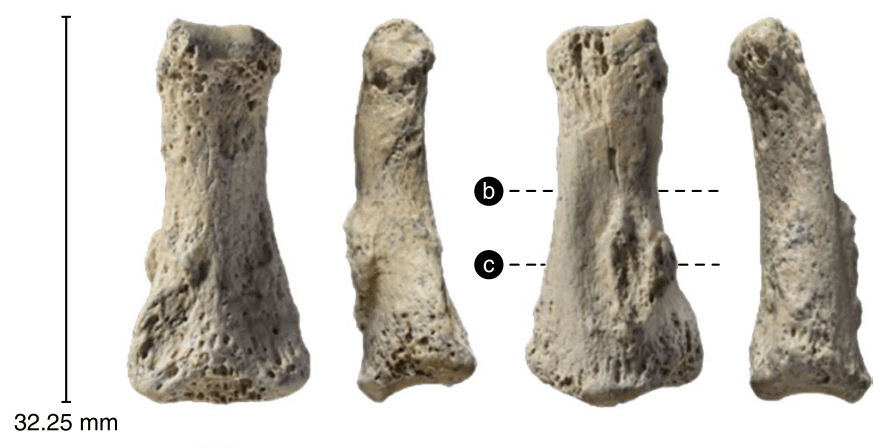
A human finger bone was found at the site of Al Wusta two years ago. It dates to about 95-86,000 years ago. Comparisons with a range of humans and Neanderthals confirm that this finger comes from a human, making it the first – and currently only – skeletal proof of the presence of humans in the Arabian Peninsula during the Middle Palaeolothic.

The one – the only – the human bone discovered at the site of Al Wusta in Saudi Arabia, dating from 95-86,000 years ago. Image taken from

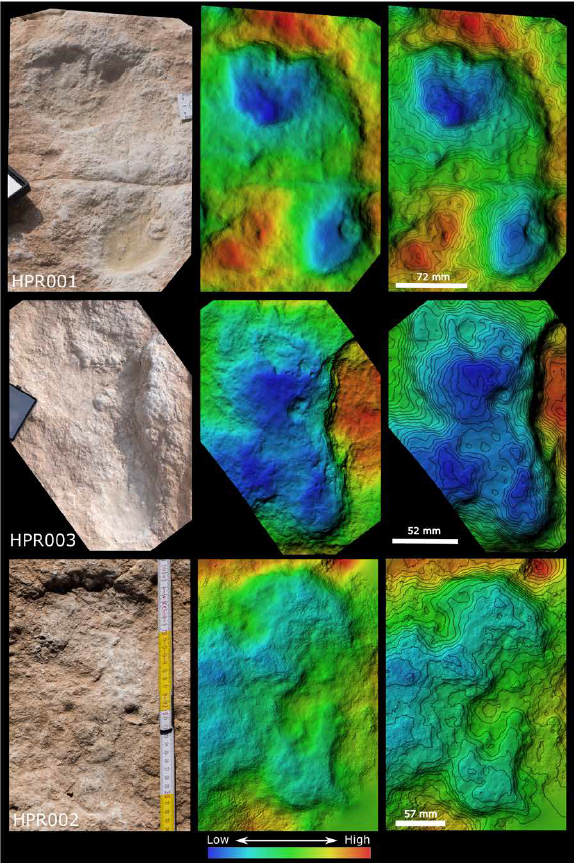
More recently, another big discovery of human presence has been made. At the site of Alathar and dating between 120 and 110,000 years ago archaeologists have found a series of footprints along the edges of a former lake. Many animals left their footprints here, including the footprints of at least two humans.

Three of the footprints found at Alathar. Photos of the individual footprints can be seen (left) as well as two Digital Elevation Models (centre and right) of the shape of each footprint. Image taken from Stewart et al 2020.

Two decades is not a lot of time in archaeology, and we are only now just scratching the surface of what the Arabian Peninsula has to tell us about its role in the lives of humans in the Palaeolithic. New discoveries are coming to light all the time, so we shall have to wait and see what new insights this peninsula can provide for the ancient lives of humans as we moved between Anatomically Modern Humans into modern humans.

Episode Bibliography:

Bar-Yosef Mayer, D.E., Vandermeersch, B. and Bar-Yosef, O. 2009. Shells and ochre in Middle Paleolithic Qafzeh cave, Israel: indications for modern behaviour. Journal of Human Evolution 56(3): 307-314.

Crassard, R., Petraglia, M.D., Drake, N.A., Breeze, P., Gratuze, B., Alsharekh, A., Arbch, M., Grocutt, H.S., Khalidi, L., Michelsen, N., Robin, C.L. and Schiettecatte, J. 2013. Middle Palaeolithic and Neolithic occupations around Mudnafan palaeolake, Saudi Arabia: implications for climate changes and human dispersals. PLOS One 8(7): e69665.

Crassard, R. and Hilbert, Y.H. 2013. A Nubian Complex site from Central Arabia: implications for Levallois taxonomy and human dispersals during the Upper Pleistocene. PLOS One 8(7): e69221.

Crassard, R., Hilbert, Y.H., Preusser, F., Wulf, G. and Schietteatte, J. 2019. Middle Palaeolithic occupations in central Saudi Arabia during MIS 5 and MIS 7: new insights on the origins of the peopling of Arabia. Archaeological and Anthropological Sciences 11: 3101-3120.

Delagnes, A., Tribolo, C. Bertran, P., Brenet, M., Crassard, R., Jaubert, J., Khalidi, L., Mercier, N., Nomade, S., Peigné, S., Sitzia, L., Tournepiche, J.-F. Al-Halibi, M., Al-Mosabi, A. and Macchiarelli, R. 2012. Inland human settlement in southern Arabia 55,000 years ago. New evidence from the Wadi Surdud Middle Paleolithic site complex, western Yemen. Journal of Human Evolution 63: 452-474.

Derevianko, A.P. 2016. The Middle Paleolithic of Arabia. Archaeology, Ethnology and Anthropology of Eurasia 44(4): 3-25.

Goder-Goldperber, M., Gobenko, N. and Hovers, E. 2016. “Diffusion with modifications”: Nubian assmblages in the central Negev highlands of Israel and their implications for Middle Paleolithic inter-regional interactions. Quaternary International 408(B): 121-139.

Grocutt, H.S., Grün, R., Zalmout, I.S.A., Drake, N.A., Armitage, S.J., Candy, I., Calrk-Wilson, R., Louys, J., Breeze, P.S., duval, M., Buck, L.T., Kivell, T.L., Pomeroy, E., Stephens, N.B., Stock, J.T., Stewart, M., Price,G.J., Kinsley, L., Sung, W.W., Alsharekh, A., Al-Omari, A., Zahir, M., Memesh, A.M., Abdulshakoor, A.J., Am-Masari, A.M., Bahameen, A.A., Al Murayyi, K.S.M., Zahrani, B., Scerri, E.M.L. and Petraglia, M.D. 2018. Homo sapiens in Arabia by 85,000 years ago. Nature Ecology & Evolution 2: 800-809.

Grocutt, H.S. and Petraglia, M.D. 2012. The prehistory of the Arabian Peninsula: deserts, dispersals and demography. Evolutionary Anthropology 21: 113-125.

Grocutt, H.S., White, T.S., Clark-Balzan, L., Parton, A., Crassard, R., Shipton, C., Jennings, R.P., Parker, A.G., Breeze, P.S., Scerri, E.M.L., Alsharekh, A. and Petraglia, M.D. 2015. Human occupation of the Arabian Empty Quarter during MIS 5: evidence from Mundafan Al-Buhayrah, Saudi Arabia. Quaternary Science Reviews 119: 116-135.

Jennings, R.P., Parton, A., Clark-Balzan, L., White, T.S., Grocutt, H.S., Breeze, P.S., Parker, A.G., Drake, N.A. and Petraglia, M.D. 2016. Human occupation of the northern Arabian interior during early Marine Isotope Stage 3. Journal of Quaternary Science 31(8): 953-966.

Jennings, R.P., Singrayer, J., Stone, E.J., Krebs-Kanzow, U., Khon, V., Nisancioglu, K.H., Pfeiffer, M., Zhang, X., Parker, A., Parton, A., Grocutt, H.S, White, T.S., Drake, N.A. and Petraglia, M.D. 2015. The greening of Arabia: multiple opportunities for human occupation of the Arabian Peninsula during the Late Pleistocene inferred from an ensemble of climate model simulations. Quaternary International 382: 181-199.

Osypinski, P. and Osypinksi, M. 2016. Optimal adjustment or cultural backwardness? New data on the latest Levallois industries in the Nile Valley. Quaternary International 408: 90-105.

Peraglia, M.D. and Alsharekh, A. 2003. The Middle Palaeolithic of Arabia: implications for modern human origins, behaviour and dispersals. Antiquity 77: 671-684.

Petraglia, M.D. and Rose, J.I. (editors) 2009. The Evolution of Human Populations in Arabia: Paleoenvironments, Prehistory and Genetics. London: Springer.

Stewart, M., Clark-Wilson, R., Breeze, P.S., Janulis, K., Candy, I., Armitage, S.J., Ryves, D.B., Louys, J., Duval, M., Price, G.J., Cuthbertson, P., Bernal, M.A., Drake, N.A., Alsharekh, A.M., Zahrani, B., Al-Omari, A., Roberts, P., Grocutt, H.S. and Petraglia, M.D. 2020. Human footprints provide snapshot of last interglacial ecology in the Arabian interior. Science Advances 6: eaba8940.

Episode 4: Neanderthals

Today we have seen that much of what exists in the popular concept of Neanderthals – as dim, stooped, hairy and primitive – is largely down to a combination of Victorian period biases in how people viewed one another (and themselves) as well as an error made in the first reconstructions of Neanderthal skeletons. While we know that this popular image of Neanderthals is wrong, it can also be hard to move away from something that we as human societies have had with us for so long.

Illustration of a Neanderthal done in 1909 by Czech artist Frantizek Kupka and based upon the reconstructions of Neanderthals (specifically of the burial from La Chapelle aux-Saints) by Marcel Boule.

Instead of the hairy and primitive animal shown in the above and other pictures, we have seen that Neanderthals looked a lot like us. They were smart and capable, just like we are. They made good use of the landscapes around where they lived, and chose their home bases with care. They invented new technologies for making composite tools, and for keeping themselves warm. Neanderthals even seem to have made decorations for themselves or their clothing, and to have used pigments to add colour to themselves and their possessions. They may even have used these pigments to make paintings on the walls of caves.

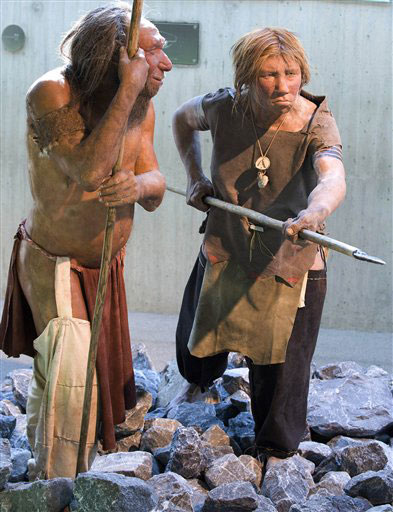
A modern reconstruction of Neanderthals
Some of the European cave paintings now dated to the time of Neanderthals. The article on the dating of these paintings can be found here.

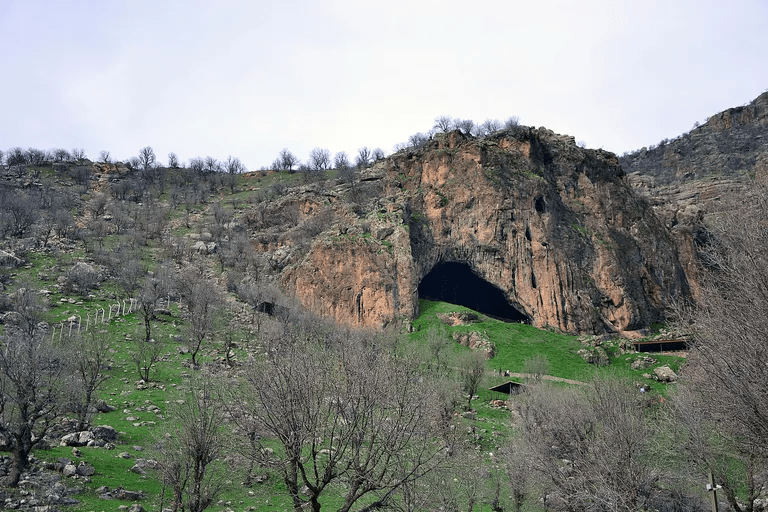
Neanderthals even buried their dead. This was not a practice which was restricted to a few Neanderthals living in only one region, but is something which we see repeatedly across the Near East and Europe. This is something which we have seen repeatedly at Shanidar cave, where many Neanderthal burials have been found. At least one of which burials may have had flowers and other plants buried with them as grave goods.

Shanidar cave in the Zagros mountains. It was inside this cave that many Neanderthal graves have been found, including a new burial recently found now that excavations have resumed. The article about this new skeleton can be found here.

Neanderthals may also have made music, as is suggested by the discovery of a small flute-like instrument from the site of Divje Babe in Slovenia. While small and currntly broken, this ‘flute’ makes beautiful music.

Episode Bibliography:

Arensburg, B., Schepartz, L.A., Tillier, A.M., Vandermeersch, B. and Rak, Y. 1990. A reappraisal of the anatomical basis for speech in Middle Palaeolithic hominids. American Journal of Physical Anthropology 83:137-146.

Bar-Yosef, O. 1998. The chronology of the Middle Palaeolithic of the Levant. In T. Akazawa, K. Aoki and O. Bar-Yosef (eds). Neanderthals and Modern Humans in Western Asia. London: Plenum Press:  39-56.

Bocherens, H. 2009. Neanderthal dietary habits: review of the isotopic evidence. In J.J. Hublin and M.P. Richards (eds.), The Evolution of Hominin Diets: Integrating Approaches to the Study of Palaeolithic Subsistence. London: Springer: 241-250.

Boëda, E., Connan, J. and Muhesen, S. 1998. Bitumen as halfting material on Middle Palaeolithic artefacts from the El Kowm Basin, Syria. In T. Akazawa, K. Aoki and O. Bar-Yosef (eds). Neanderthals and Modern Humans in Western Asia. London: Plenum Press:  181-204.

Burdukiewicz, J.M. 2014. The origin of symbolic behaviour of Middle Palaeolithic humans: recent controversies. Quaternary International 326-327: 398-405.

Gibson, K.R. 2007 Putting it all Together: a constructionist approach to the evolution of human mental capacities. In P. Mellars, K. Boyle, O. Bar-Yosef and C Stringer (eds.), Rethinking the Human Revolution: New Behavioural and Biological Perspectives on the Origins and Dispersal of Modern Humans. Cambridge: McDonald Institute Monographs: 67-78.

Hardy, B.L., Moncel, M.-H., Daujeard, C., Fernandes, P., Béarez, P., Desclaux, E., Chacon Navarro, M.C., Puaud, S. and Gallotti, R. 2013. Impossible Neanderthals? Making string, throwing projectiles and catching small game during Marine Isotope Stage 4 (Abri du Maras, France). Quaternary Science Reviews 82: 23-40.

Henry, D.O., Belmaker, M. and Bergin, S.M. 2017. The effect of terrain on Neanderthal ecology in the Levant. Quaternary International 435: 94-105.

Heydari-Guran, S. and Ghasidian, E. 2020. Late Pleistocene hominin settlement patterns and population dynamics in the Zagros mountains: Kermanshah region. Archaeological Research in Asia 21: 100161.

Hoffmann, D.L., Standish, C.D., Garcia-Diez, M., Pettit, P.B., Milton, J.A., Zilhão, J., Alcolea-Gonzalex, J.J., Cantalejo-Duarte, P., Collado, H., de Balbin, R., Lorblanchet, M., Ramos-Munoz, J., Weniger, G.-Ch. and Pike, A.W.G. 2018. U-Th dating of carbonate crusts revels Neanderthal origin of Iberian cave art. Science 359: 912-915.

Hoffmann, D.L., Standish, C.D., Pike, A.W.G., Garcia-Diez, M., Pettit, P.B., Angelucci, D.E., Villaverge, V., Zapata, J., Milton, J.A., Alcolea-Gonzalez, J., Cantalejo-Duarte, P., Collado, H., de Balbin, R., Lorblanchet, M., Ramos-Munoz, G., Weniger, G.-Ch. and Zilhao, J. 2018. Dates for Neanderthal art and symbolic behaviour are reliable. Nature Ecology and Evolution 2: 1044-1045.

Hublin, J.J. Climate changes, paleogeography, and the evolution of the Neandertals. In T. Akazawa, K. Aoki and O. Bar-Yosef (eds), Neanderthals and Modern Humans in Western Asia. London: Plenum Press: 295-310.

Hublin, J.J. 2007. What can Neanderthals tell us about modern human origins?

Lieberman, D.E. 1998. Neandertal and early modern human mobility patterns: comparing archaeological and anatomical evidence. In T. Akazawa, K. Aoki and O. Bar-Yosef (eds), Neanderthals and Modern Humans in Western Asia. London: Plenum Press: 263-275.

McGill, L. 2017. Neanderthal behavioral modernity and symbolic capacities. Field Notes: A Journal of Collegiate Anthropology 7(1): 60-74.

Nasab, H.V. and Hashemi, M. 2016. Playas and Middle Paleolithic settlement of the Iranian Central Desert: the discovery of the Chach- Jam Middle Paleolithic site. Quaternary International 408: 140-152.

Nielsen, T.K. 2012. Use of red ochre by early Neanderthals. Proceedings of the National Academy of Sciences (PNAS) 109(6): 1889-1894.

Nitu, E.-C. 2015. Some observations on the supposed natural origin of the Divje Babe I flute. Annales D’Université Valahia Targoviste 16(2): 33-46.

Pinhasi, R. Gasparian, B., Wilkinson, K., Bailey, R., Bar-Oz, G., Bruch, A., Chataigner, C., Hoffmann, D., Hovsepyan, R., Nahapetyan, S., Pike, A.W.G., Schrevke, D. and Stephens, M. 2008. Hovk 1 and the Middle and Upper Paleolithic of Armenia: a preliminary framework. Journal of Human Evolution 55: 803-816.

Pomeroy, E. Bennett, P., Hunt, C.O., Renolds, T., Farr, L., Frouin, M., Holman, J., Lane, R., French, C. and Barker, G. 2020. New Neanderthal remains associated with the ‘flower burial’ at Shanidar Cave. Antiquity 373: 11-26.

Serangeli, J. and Bolus, M. 2008. Out of Europe – the dispersal of a successful European hominin form. Quartär 55: 83-98.

Shea, J.J. 2008. Transitions or turnovers? Climatically-forced extinctions of Homo sapiens and Neanderthals in the east Mediterranean Levant. Quaternary Science Reviews 27: 2253-2270.

Slimak, L., Kuhn, S.L., Roche, H., Mouralis, D., Buitenhuis, H., Balkan-Atli, N., Binder, D., Kuzucuoğlo, C. and Guillou, H. 2008. Kaletepe Deresi 3 (Turkey): archaeological evidence for early human settlement in Central Anatolia. Journal of Human Evolution 54: 99-111.

Speth, J.D. and Tchernov, E. 1998. The role of hunting and scavenging in Neandertal procurement strategies. In T. Akazawa, K. Aoki and O. Bar-Yosef (eds), Neanderthals and Modern Humans in Western Asia. London: Plenum Press: 223-239.

Sykes, R.W. 2020. Kindred: Neanderthal Life, Love, Death and Art. London: Bloomsbury Sigma.

Vandermeersch, B. and Garralda, M.D. 2011. Neanderthal geographical and chronological variation. In S. Condemi and G.-C. Weniger (eds.), Continuity and Discontinuity in the Peopling of Europe: One Hundred Fifty Years of Neanderthal Study. London: Springer: 113-125.

Walker, M.J.C., Berkelhammer, M., Björck,S., Cwynar, L.C., Fisher, D.A., Long, A.J., Lowe, J.J., Newnham, R.M., Rasmussen, S.O. and Weiss, H. 2012. Formal subdivision of the Holocene Series/Epoch: a discussion paper by a working group of INTIMATE (integration of ice-core, marine and terrestrial records) and the Subcommission on Quaternary Stratigraphy (International Commission on Stratigraphy). Journal of Quaternary Science 27(7): 649-659.

Zilhão, J. 2012. Personal ornaments and symbolism among the Neanderthals. Developments in Quaternary Science 16: 35-49.

Episode 3: Making the Middle Palaeolithic

About 215,000 years ago, Lower Palaeolithic of the Near East transitioned into the Middle Palaeolithic. The overall pattern of life which we saw in the Lower Palaeolithic – moving across the landscape hunting animals and gathering plants – has not changed as we move into the Middle Palaeolithic. However, enough has changed about people and the things which they left behind that this is recognised as a distinct new phase in the archaeology of the Near East.

The tradition of making and using stone tools which we see during the Middle Palaeolithic is no longer the Acheulean tradition of the Lower Palaeolithic, but is the Mousterian. One of the big technical components of the Mousterian which helps to set it apart from the stone tools of earlier (as well as later) time periods is what we call the Levallois technique. This is named for the suburb of Paris where stone tools made using this technique were found in the 19th century. The earlier Acheulean tradition removed excess bits of stone from a core in order to create a handaxe or another tool from the centre. The Levallois technique is a big change from this approach, as now the core is carefully shaped not to make a tool out of the centre but in order to remove a large flake which is then made into a tool. This means that multiple tools can be made out of the same core, and that you can be really flexible with what tools you want to (and are able to) make at each stage of the manufacturing process. Also, as you can see in the linked video below, working a core in order to remove large flakes which are turned into tools rather than removed in order to shape a single tool means that you can now make more tools from a single core.

Shaping a core to remove a large flake using Levallois. From Schlanger 1996: Figure 1 (see bibliography). The rest of the article can be found here.

Some of these Levallois flakes were turned into a new technological achievement of the Middle Palaeolithic – spearpoints. Hunting spears in the Lower Palaeolithic were made with one end of the wooden shaft sharpened to a point. While these would have done the job of sticking animals, adding a razor-sharp stone point to these spear shafts would have improved your ability to stick a spear deep into an animal during hunting. These spear points not only upgraded hunting equipment of the Middle Palaeolithic, but people seem to have worked out a neat new method for keeping these points attached to the spears – they glued them in place. Bitumen is a natural sticky tar that can be found when petroleum seeps to the surface in the Near East. In the Middle Palaeolithic this bitumen was used as a glue to help stick stone spearpoints onto spears, which is the oldest ever case of bitumen glue which we have found.

Of course, the common use of these new techniques for making stone tools were not the only things which made life in the Middle Palaeolithic different from life in the Lower Palaeolithic. At the end of the Lower Palaeolithic we started to see a bit of a change along the coast where people were starting to camp in caves and regularly make fires. This use of caves expands in the Middle Palaeolithic and we now pretty commonly see base-camps in caves across the whole Near East. These may not have been places where people stayed for very long at any one visit, but this did not mean that no one bothered to make them comfortable.

Tor Faraj rockshelter in Jordan as seen during its excavation. Image from Henry 2003, page 44.

A great example of how life camping in caves was made comfy comes from the rockshelter of Tor Faraj in Jordan. Tor Faraj was one of these base camp caves used by people in the Middle Palaeolithic. It was excavated fairly recently (during the 1980s and 1990s) and was used as a rotating base camp by Neanderthals living in the Levant during the later stages of the Middle Palaeolithic, about 70,000 to 50,000 years ago.

Activity areas used by Neanderthals at Tor Faraj based upon evidence from excavations. Image taken from Henry 2012. The rest of the article can be found here.

Thanks to very careful excavation and lots of systematic sampling of the sediments excavated throughout the cave we can see that the people living in Tor Faraj divided the cave up based on what activities they needed to do with each one having its own space. Areas for making sharp stone tools were kept away from areas for sleeping, and even in tool-making areas the larger flakes of stone were collected and tossed against the walls out of the way. This meant that the areas where stone tools were made were full of tiny little flakes of sharp stone which show us where the tools were made, but the big pieces which could cut your feet as you waked around were cleared up and thrown away where they would not be stepped on. Tor Faraj even seems to have had an entrance barricade made of bushes and brush, either to help protect people from predators while they slept or to help with keeping out the wind.

Episode Bibliography:

Bar-Yosef, O. 1998. The chronology of the Middle Palaeolithic of the Levant. In T. Akazawa, K. Aoki and O. Bar-Yosef (eds). Neanderthals and Modern Humans in Western Asia. London: Plenum Press:  39-56.

Boëda, E., Connan, J. and Muhesen, S. 1998. Bitumen as halfting material on Middle Palaeolithic artefacts from the El Kowm Basin, Syria. In T. Akazawa, K. Aoki and O. Bar-Yosef (eds). Neanderthals and Modern Humans in Western Asia. London: Plenum Press:  181-204.

Gibson, K.R. 2007 Putting it all Together: a constructionist approach to the evolution of human mental capacities. In P. Mellars, K. Boyle, O. Bar-Yosef and C Stringer (eds.), Rethinking the Human Revolution: New Behavioural and Biological Perspectives on the Origins and Dispersal of Modern Humans. Cambridge: McDonald Institute Monographs: 67-78.

Goren-Inbar, N. and Belfer-Cohen, A. 1998. The technological abilities of the Levantine Mousterians: cultural and mental capacities. In T. Akazawa, K. Aoki and O. Bar-Yosef (eds). Neanderthals and Modern Humans in Western Asia. London: Plenum Press: 205-221.

Henry, D.O. 1998. Intrasite spatial patterns and behavioural modernity. Indications from the Late Levantine Mosterian rockshelter at Tor Faraj, southern Jordan. In T. Akazawa, K. Aoki and O. Bar-Yosef (eds). Neanderthals and Modern Humans in Western Asia. London: Plenum Press:  127-142.

Henry, D.O. 2003. Neanderthals in the Levant: Behavioural Organization and the Beginnings of Human Modernity. London: Continuum.

Henry, D.O. 2012. The palimpsest problem, hearth pattern analysis, and Middle Palaeolithic site structure. Quaternary International 247: 246-266.

Howell, C.F. 1998. Evolutionary implications of altered perspectives on hominine demes and populations in the later Pleistocene of western Eurasia. In T. Akazawa, K. Aoki and O. Bar-Yosef (eds). Neanderthals and Modern Humans in Western Asia. London: Plenum Press: 5-27.

Lieberman, D.E. 1998. Neandertal and early modern human mobility patterns: comparing archaeological and anatomical evidence. In T. Akazawa, K. Aoki and O. Bar-Yosef (eds). Neanderthals and Modern Humans in Western Asia. London: Plenum Press: 263-275.

Meignen, L., Bar-Yosef, O., Speth, J.D. and Stiner, M.C. 2006. Middle Palaeolithic settlement patterns in the Levant. In **** 149.

Ray, Y. 1998. Does any Mousterian cave present evidence of two hominid species? In T. Akazawa, K. Aoki and O. Bar-Yosef (eds). Neanderthals and Modern Humans in Western Asia. London: Plenum Press: 352-366.

Rollefson, G.O. 2019. The Lower and Middle Palaeolithic of the Southern Levant. In A. Yasur-Landau, E.H. Cline and Y.M. Rowan (eds.), The Social Archaeology of the Levant: From Prehistory to the Present. Cambridge: Cambridge University Press: 9-28.

Sharon, G. 2018. A week in the life of the Mousterian hunter. In Y. Nishiaki and T. Akazawa (eds.), The Middle and Upper Paleolithic Archaeology of the Levant and Beyond. London: Springer: 35-47.

Shea, J.J. 2007. The boulevard of broken dreams: evolutionary discontinuity in the Late Pleistocene Levant. In P. Mellars, K. Boyle, O. Bar-Yosef and C. Stringer (eds.), Rethinking the Human Revolution: New Behavioural and Biological Perspectives on the Origins and Dispersal of Modern Humans. Cambridge: McDonald Institute Monographs: 219-232.

Schlanger, N. 1996. Understanding Levallois: lithic technology and cognitive archaeology. Cambridge Archaeological Journal 6(2): 231-254.

Speth, J.D. and Tchernov, E. 1998. The role of hunting and scavenging in Neandertal procurement strategies. In T. Akazawa, K. Aoki and O. Bar-Yosef (eds). Neanderthals and Modern Humans in Western Asia. London: Plenum Press: 223-239.

Zaidner, Y, Centi, L., Revost, M., Shemer, M., and Varoner,O. 2018. An open-air site at Neshler Ramla, Israel, and new insights into Levantine Middle Paleolithic technology and site use. In Y. Nishiaki and T. Akazawa (eds.), The Middle and Upper Paleolithic Archaeology of the Levant and Beyond. London: Springer: 11-33.

Episode 2: the Lower Palaeolithic in the Near East

The archaeological record in the ancient Near East begins with the Lower Palaeolithic, when Homo erectus wandered out of Africa some time a little less than two million years ago and spread out across Europe and Asia. It is the evidence from the lives of these people which we have across the Near East that form the Lower Palaeolithic.

The oldest evidence of people in the Near East that we currently know of is from about 1.2 to 1.6 million years ago and comes from two sites both dating to this time window. ‘Ubeidiya, an open-air site along a river in the Jordan Valley has provided a deep sequence of Acheulean stone tools and a few remains of people, which were probably Homo erectus. Kocabaş, a quarry site in Turkey, has yielded parts of the skull from a single Homo erectus from this same time. From the time of these earliest sites until the end of the Lower Palaeolithic about 215,000 years ago, we find evidence of Homo erectus and Acheulean stone tools across the Near East. To see how these Acheulean stone tools were made, check out a video of the process here.

How to make an Acheulean hand axe

We do not have a massive quantity of sites from the Lower Palaeolithic, and the number of sites which we have found increases as we get into younger periods of the Lower Palaeolithic. We have more sites from the Middle Acheulean (after about 800,000 years ago) than we do from the Early Acheulean (before this). We have enough sites from the Middle Acheulean to see differences in the shape of stone tools between sites of the coast and those of the more eastern parts of the Near East. This division seems to continue into the Late Acheulean, after about 600,000 years ago.

By 400,000 years ago, we see some significant changes in the way that people living in areas closer to the Mediterranean coast lived, made tools and used the landscape in the development of the Acheulo-Yabrudian complex. These people spent more time staying in caves, regularly made fires and improved their technology for making tools. Some of the best evidence that we for changes in the way that people lived during this final stage of the Lower Palaeolithic comes from a few recent cave excavations in the southern Levant, such as those at Qesem Cave and Zuttiyeh Cave.

Views of Qesem and Zuttiyeh caves.
To find out more about these cave sites, click on the links in the text above.

Episode Bibliography:

Agam, A. 2020. Late Lower Palaeolithic lithic procurement and exploitation strategies: a view from Acheulo-Yabrudian Qesem Cave (Israel). Journal of Archaeological Science: Reports 33: 102447.

Agam, A., Azuri, I., Pinkas, I., Gopher, A. and Natalio, F. 2020. Estimating temperatures of heated Lower Palaeolithic flint artefacts. Nature Human Behaviour https://doi.org/10.1038/s41562-020-00955-z

Barkai, R., Rosell, J., Blasco, R. and Gopher, A. 2017.Fire for a reason: barbecue at Middle Pleistocene Qesem Cave, Israel. Current Anthropology 58(S16): S314-S328.

Bar-Yosef, O., and Belfer-Cohen, A. 2001. From Africa to Eurasia – early dispersals. Quaternary International 75: 19-28.

Bar-Yosef, O. and Belmaker, M. 2011. Early and Middle Pleistocene faunal and hominins dispersals through southwestern Asia. Quaternary Science Reviews 30: 1318-1337.

Belmaker, M., Tchernov, E., Condemi, S. and Bar-Yosef, O. 2002. New evidence for hominid presence in the Lower Pleistocene of the southern Levant. Journal of Human Evolution 43(1): 43-56.

Ben-Dor, M., Gopher, A., Hershkovits, I. and Barkia, R. 2011. Man the fat hunter: the demise ofHomoerectus and the emergence of a new hominin lineage in the Middle Pleistocene (c.400 kyr) Levant. PLOS One 6(12): e28689.

Blasco, R., Rosell, J., Gopher, A. and Barkai, R. 2014.Subsistence economy and social life: a zooarchaeological view from the 300 kya central hearth at Qesem Cave, Israel. Journal of Anthropological Archaeology 35:248-268.

Dennell, R.2003. Dispersal and colonisation, long and short chronologies: how continuous is the Early Pleistocene record for hominids outside East Africa? Journal of Human Evolution 45: 421-440.

Enzel, Y.and Bar-Yosef, O. (eds.). 2017. Quaternary of the Levant: Environments, Climate Change and Humans. Cambridge: Cambridge University Press.

Gopher, A., Ayalon, A., Bar-Matthews, M., Barkai, R., Frumkin, A., Karkanas, P. and Shahack-Gross, R. 2010. The chronology of the late Lower Palaeolithic in the Levant based on U-Th ages of speleothems from Qesem Cave, Israel. Quaternary Geochronology 5: 644-656.

Hardy, K. 2018. Plant use in the Lower and Middle Palaeolithic: food, medicine and raw materials. Quaternary Science Reviews 191: 393-405.

Hardy, K., Radini, A., Buckley, S., Sarig, R., Copeland, L., Gopher, A. and Barkai, R. 2016. Dental calculus reveals potential respiratory irritants and ingestion of essential plant-based nutrients at Lower Palaeolithic Qesem Cave Israel. Quaternary International 398: 129-135.

Kuhn, S.L. and Stiner, M.C. 2019. Hearth and home in the Middle Pleistocene. Journal of Anthropological Research 75(3): 305-327.

Porat, N., Chazan, M., Schwarcz, H., Horwitz, L.K., 2002. Timing of the Lower to Middle Palaeolithic boundary: new dates from the Levant. Journal of Human Evolution 43: 107-122.

Shea, J.J. 2007. The Boulevard of broken dreams: evolutionary discontinuity in the Late Pleistocene Levant. In P. Mellars, K. Boyle, O. Bar-Yosef and C. Stringer (eds.), Rethinking the Human Revolution: New Behavioural and Biological Perspectives on the Origins and Dispersal of Modern Humans. Cambridge: McDonald Institute Monographs: 219-234.

Shimelmitz, R., Kuhn, S.L., Jelinek, A.J., Ronen, A., Clark, A.E. and Weinstein-Evron, M. 2014. ‘Fire at will’: the emergence of habitual fire use 350,000 years ago. Journal of Human Evolution 77: 196-203.

Vialet, A., Prat, S., Wils, P. and Alçiçek, M.C. 2018. The Kocabaş hominin (Denizli Basin, Turkey) at the crossroads of Eurasia: new insights from morphometric and cladistic analysis. Comptes Rendus Palevol 17: 17-32.

Zupanich, A., Ninziante-Cesaro, S., Blasco, R., Rosell, J., Cristiani, E., Venditti, F., Lemori, C., Barkai, R. and Gopher, A. 2016. Early evidence of stone tool us in bone working activities at Qesem Cave, Israel. Nature Scientific Reports 6: 37686.

Episode 1: People and humans, a family story

The long road between our last common ancestor with apes and modern humans is a fascinating area of archaeological research. Many different species of ancient people have been found from the last seven million years, including both our ancestors as well as some more distant cousins. I hope that you enjoyed the short (ish) summary of our evolution. Let me know if you have any questions or comments, and please come back and listen to the episode next week on the earliest archaeology of the ancient Near East.

If you would like to know more about the study of human evolution, or would like to see reconstructions of what our ancient family members may have looked like, there are some excellent resources available. Reconstructions and summaries of ancient people species by the Smithsonian Institution can be found on their Human Origins research page here. This page also has lovely examples of the Oldowan and Acheulean tools described in the episode.

If you would like to read more on human evolution – and what it is like to study – then I can recommend a couple of enjoyable books as well:

Lee Berger and John Hawks. 2017. Almost Human: The Astonishing Tale of Homo naledi and the Discovery that Changed our Human Story.

Mark Maslin. 2017. The Cradle of Humanity: How the Changing Landscape of Africa Made us so Smart.

Episode Bibliography:

Berger, L. and Hawks, J. 2017. Almost Human: The Astonishing Tale of Homo naledi and the Discovery that Changed our Human Story. Washington, D.C.: National Geographic.

Bramble, D.M. and Lieberman, D.E. 2004. Endurance running and the evolution of HomoNature 432: 345-352.

Clarke, R.J. 2012. A Homo habilis maxilla and other newly discovered hominid fossils from Olduvai Gorge,Tanzania. Journal of Human Evolution 63: 418-428.

Domínguez-Rodrigo, M., Pickering, T.R., Semaw,S. and Rogers,M.J. 2005. Cutmarked bones from Pliocene archaeological sites at Gona, Afar, Ethiopia: implications for the function of the world’s oldest stone tools. Journal of Human Evolution 48: 109-121.

Haeusler, M. and McHenry, H.M. 2004. Body proportions of Homo habilis reviewed. Journal of Human Evolution 46: 433-465.

Haile-Selassie, Y., Saylor, B.Z., Deino, A., Alene, M. and Latimer, B.M. 2010. New hominid fossils from Woranso-Mille (Central Afar, Ethiopia) and taxonomy of early Australopithecus. American Journal of Physical Anthropology 141: 406-417.

Herries, A.L., Martin, J.M., Leece, A.B., Adams, J.W., Boschian, G., Johannes-Boyau, R., Edwards, T.R., Mallett, T., Massey, J., Murszewski, A., Neubauer, S., Pickering, R., Strait, D.S., Armstrong, B.J., Baker, S., Caruana, M.V., Denham, T., Hellstrom, J., Moggi-Cecchi, J., Mokobane, S., Penzo-Kajewski, P., Rovinsky, D.S., Schwarts, G.T., Stammers, R.C., Wilson, C., Woodhead, J. and Menter, C. 2020. Contemporaneity of Australopithecus, Paranthropus, and early Homo erectus in South Africa. Science 368(47): 1-19.

Hetherington, R. 2012. Living in a Dangerous Climate: Climate Change and Human Evolution. Cambridge: Cambridge University Press.

Hlubik, S., Berna, F., Feibel, C., Braun, D. and Harris, J.W.K. 2017. Researching the nature of fire at 1.5 Mya on the site of FxJj20 AB, Koobi For a, Kenya using high-resolution spatial analysis and FTIR spectrometry. Current Anthropology 58(Supplement 16): S243-S257.

Hublin, J.-J., Ben-Ncer, A., Bailey, S.E., Freidline, S.E., Neubauer,S., Skinner, M.M., Bergmann, I., Le Cabec, A., Benazzi,S., Harvati, K. and Gunz, P. 2017. New fossils from Jebel Irhoud, Moroccoand the pan-African origin of Homo sapiens. Nature 546: 289-292.

Lovejoy, C.O., Suwa, G., Simpson, S.W., Matternes, J.H. and White, T.D. 2009. The great diides: Ardipithecus ramidus reveals the postcrania of our last common ancestors with African apes. Science 326: 100-106.

Maslin, M. 2017. The Cradle of Humanity: How the Changing Landscape of Africa Made us so Smart. Oxford: Oxford University Press.

Profico,A., Di Vincenzo,F., Gagliardi, L., Piperno, M. and Manzi, G. 2016. Filling the gap. Human cranial remains from GomboreII (Melka Kunture, Ethiopia; ca. 850ka) and the origin of Homo heidelbergensisJournal of Anthropological Sciences 94: 1-24.

Reno, P.L., Meindl, R.S., McCollum, M.A. and Lovejoy, C.O. 2003. Sexual dimorphism in Australopithecus afarensis was similar to that of modern humans. Proceedings of the National Academy of Sciences 100(16): 9404-9409.

Rightmire, C.P. 2013. Homo erectus and Middle Pleistocene hominins: brain size, skull forms and species recognition. Journal of Human Evolution 65(3): 223-252.

Simpson, S.W., Quade, J., Levin, N.E., Butler, R., Dupont-Nivet, G., Everett, M. and Semaw, S. 2008. A female Homo erectus pelvis from Gona, Ethipoia. Science 322: 1089-1092.

Stout, D. Semaw, S., Rogers, M.J. and Cauche, D. 2010. Technological variation in the earliest Oldowan from Gona Afar, Ethiopia. Journal of Human Evolution 58: 474-491.

Henke, W. and Tattersall, I. 2013 Handbook of Paleoanthropology Volume 3: Phylogeny of Hominines. London: Springer.

Thoth, N. and Schick, K.2018. An overview of the cognitive implications of the Oldowan Industrial Complex. Azania: Archaeological Research in Africa 53(1): 3-39.

Thoth, N. and Schick, K. 2009. The Oldowan: the tool making of early hominins and chimpanzees compared. Annual Review of Anthropology 38: 289-305.

Ward, C.V. 2002. Interpreting the posture and locomotion of Australopithecus afarensis: where do we stand? Yearbook of Physical Anthropology 45: 185-215.

Ward, C.V., Plavcan, J.M. and Manthi, F.K. 2010. Anterior dental evolution in the Australopithecus anamensis-afarensis lineage. Philosophical Transactions of the Royal Society B 365: 3333-3344.

White, T.D., Asfaw, B., Beyene, Y., Haile-Selassie, Y., Lovejoy, C.O., Suwa, G. and WoldeGabriel, G. 2009. Ardipithecus ramidus and the paleobiology of early hominids. Science 326: 64-86.